


Miss Saigon
- Finlay Cooper

- Aug 18, 2023
- 4 min read
An electrifying, heart-pounding and refreshingly contemporary revival, Sheffield Crucible's visionary take on the beloved musical is a shining example of the power of artistic direction; while the show may not be flawless, Hastie and Lau's creative team have executed a dazzling new form for Miss Saigon that cleverly re-invigorates it for the 21st century.

Perhaps one of the most well known musicals of all time, Boublil and Schönberg's Miss Saigon stands as one of the most spectacular mega-musicals of its age: it's sweeping score, tragic romance and thrilling action have allowed the musical to endure the test of time. Transforming such a large scale musical into an intimate and and minimalistic revival may sound like an impossible task, and yet the endlessly talented creative team pull of the translation with ease, and thanks to genius staging, impactful lighting and thought provoking new takes on characters, this physically smaller production feels emotionally grander than ever before.
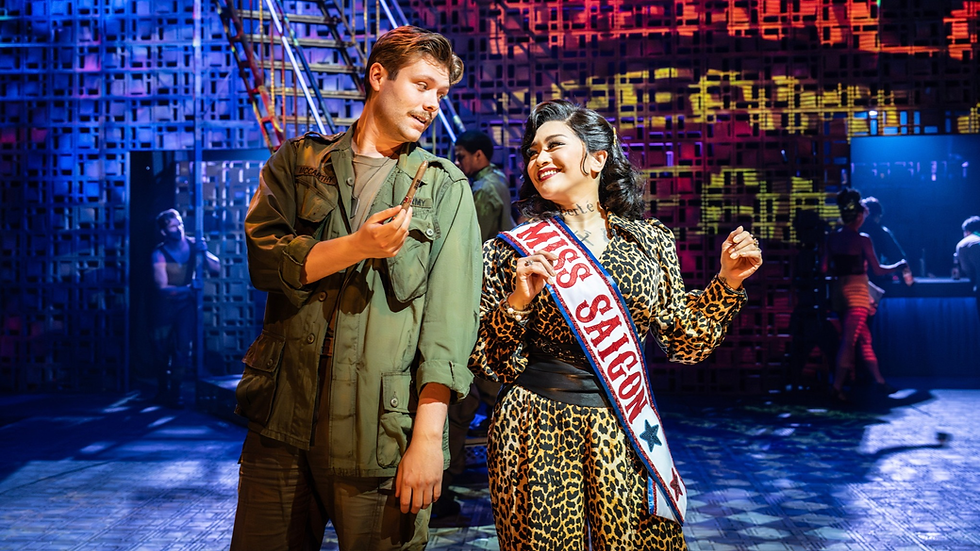
It would be fair to say that Miss Saigon has garnered unfavourable criticism as of late: the critique of its portrayal of Asian women and its echoes of 'white saviourism' have painted the show in an outdated light, and cumulating with this year's Untitled F*ck M*ss S**gon Play - a show I saw prior to this and found a brilliantly enlightening watch. This first non-replica revival of the problematic original certainly takes strong swings in attempting to correct these outdated representations and on the most part succeeds brilliantly. Gone is the 'rice picker' racism, the helpless Kim and a more diverse cast of 'Americans' that once rooted the show in troublesome cliches, and replaced with direction that gifts the Vietnamese characters with far more agency. The most dramatic of these changes, however, is Joanna Ampil as the cleverly gender-swapped Engineer, whose feminised take on the character presents an enlightening dynamic on the objectified lives of the Saigon girls. Ampil's take on the role sees much more sympathy and benevolance towards the other women of the story, and feels very much a victim herself; within the Bangkok segment of the show, the Engineer ends up reduced in many ways to the same image of sexualisation that she profited off within Vietnam. The same success cannot be said of every change, however, as an empowered Kim in many instances works more to devalue the tragedy and thus emotional impact of her story, than to uplift the character with a modernised resonance - when Kim seems strong enough to survive on her own, her ultimate abandonment by Chris feels more so inconvenient than disastrous.

Drastic changes are not limited to the book and characters: Miss Saigon receives a dazzling and energetic cosmetic reinvention, creating a dynamic world of neon and TV static. Sleek and modern, Jessica Hung Han Yun's lighting design and Andrzej Goulding's video design form a beautifully harmonious spectacle, transforming Ben Stone's detailed and thoughtful, yet minimalist set in to a chameleon-esque space of expressionism and maximalist world building. Somewhat surprisingly, the show's staging thrives most greatly in its most spectacular moments - the end of Act 1, Kim's Nightmare and Bangkok - which use creative solutions to stage theatrical iconography upon a far barer stage to great success. Equally, opposite to what one may expect, it is the smaller, more intimate moments of the show that feel most at odds with the Crucible's blank canvas; character solos and duets feel static and unweilding at times, as the barren thrust stage presents little visual intrigue to offset the occasionally mundane songwriting. That being said, the creative vision for the show is nothing short of remarkable, and the show has skillfully executed a fresh and distinct vision for what was once a well established and traditional show.
Any lingering qualms with the show are due to its source material - although an international sensation and a beloved classic, Miss Saigon isn't a flawless musical. Boublil and Schönberg's compositions too often stray into the realms of a bloated mess of a sappy song soup, and unlike in the writing duo's other hit (Les Miserables), the score here fails to justify its sung through nature, with many scenes begging to be spoken rather than sung through. Problems with the book equally persist, with a rushed romance between the two leads and an inconsistent pace making for an emotionally disconnecting story that ought to thrive on its empathetic resonance and weight. That's not to say that Miss Saigon is a poor piece of work - numbers such as Bui Doi, The American Dream and The Last Night of the World are phenomenal, as is the impressive scale of the tale that unfolds - however, its easy to appreciate the controversy in this show that thrives on sensationalised melodrama and cliche.

The aim of a revival is to shed new light on pre-established works, and in this way, the Crucible's Miss Saigon is a phenomenal show, entirely reimaging the show with a succinct and definitive vision that almost makes you forget that the show was every any different. Unfortunately, in the shift to minimalism, much of the extravagance that once masked weaknesses are removed and while this elevates the emotional intensity of the narrative's most climatic moments, it equally leaves the material's weakest moments - namely a flimsy central relationship - on full show. That being said, in this brilliant spectacle of ingenius creativity, the team at the Crucible have well and truly proven that often 'less is more'.
Miss Saigon has now closed at the Sheffield Crucible.
[Watched: 12/08/23]
Photography Credit: Johan Persson


Comments